
TOMBSTONE ARIZONA'S HISTORY & INFORMATION JOURNAL
TOMBSTONE ARIZONA'S HISTORY & INFORMATION JOURNAL
China Mary: Separating Fact from Tombstone Legend
What can—and can’t—be proven about China Mary
by Janice Hendricks and Kathy Franz
From the March 2026 issue of Tombstone Times
China Mary: Separating Fact from Tombstone Legend
What can—and can’t—be proven about China Mary
by Janice Hendricks and Kathy Franz
From the March 2026 issue of Tombstone Times
 Legends make up a lot of the Tombstone story. Legends become legends when facts can’t be proven; the stories retold so many times one has to wonder where they all started. One of those stories that has been difficult to authenticate in the annals of Tombstone’s history is the existence of a woman whose legend is spoken of often but seldom backed up with facts. The newspapers of the day spoke little of her, later books told her story with legendary tales—tales that, although filled with rich and vivid descriptions, may, like so many others in Tombstone history, be just that: a legend embellished with colorful words meant to sell books.
It has been written that China Mary ruled the Chinese section of Tombstone, that she ran a store which carried a variety of merchandise, that she ran a welfare and employment agency that helped those in need, that she would emphatically guarantee the service of her Chinese laborers, and that she even kindly took care of the town’s prostitutes, supplying them with opium in order to ease their tragic circumstances.
Billy King’s Tombstone by C. L. Sonnichsen, published in 1942, was the first book to include this particular Chinese woman. His description of her being “…no slip of a girl in those days, though she was robust and healthy and still enjoyed wearing rich silks and rare jewelry” has been repeated and retold in other books, movies, and business concepts even to this day.
Grace McCool’s Gunsmoke, published in 1954, continued the legend and referred to her as “Queen of Hop Town,” running an official welfare and employment agency, calling her “one of the best loved women in Tombstone.”
In 1972, another author taking up the mantle of telling the China Mary story, Odie B. Faulk, wrote in his book Tombstone – Myth and Reality: “…And the Chinese. Who could forget China Mary?”
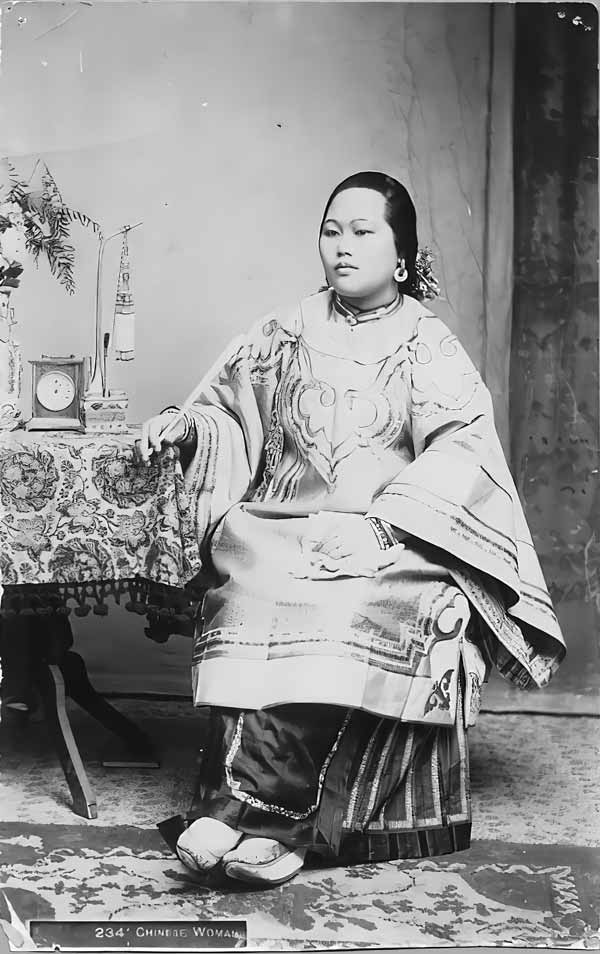
Later, in 1989 and again in 1992, Tombstone historian Ben T. Traywick included her in his books The Chinese Dragon and then Legendary Characters of Southeast Arizona. Both included an image of a robust Chinese woman he claimed was China Mary and repeated what others before him had written.
With all these books and stories retold again and again, what can we truthfully find about Tombstone’s China Mary? Who was she really? Is it provable that she truly was a Chinese woman who garnered extreme respect from her people and many others in Tombstone? And if so, why was her story not documented in newspaper accounts of the time or since? The story of a woman – no matter the name – who ran a Chinatown section of any old west town, much less Tombstone has never been documented at the Chinese California Historical Society or anywhere to this day. So, what can we prove?
The Quest – Proving Her Existence
The first official document found about China Mary was her funeral notice in newspapers in December 1906.
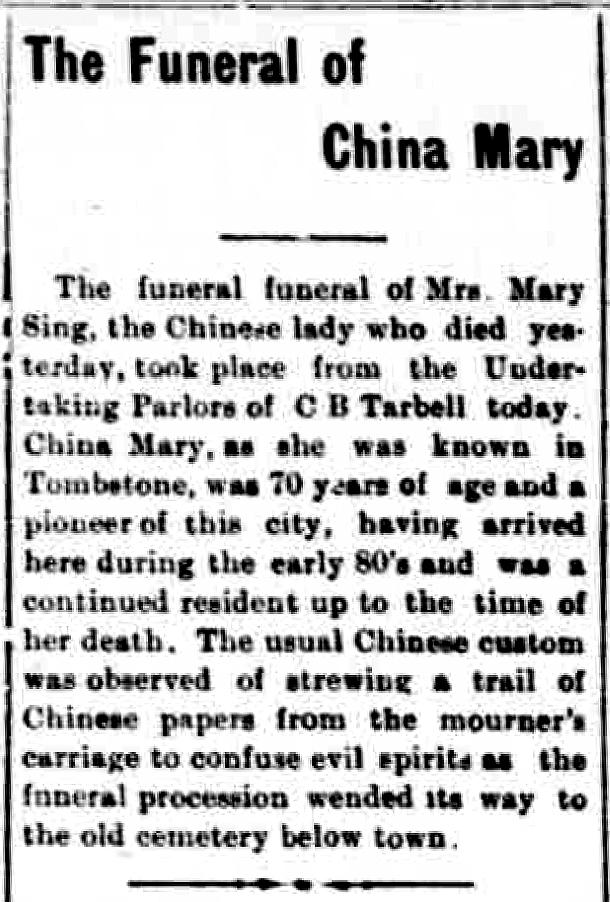 “The funeral of Mrs. Mary Sing, the Chinese lady who died yesterday, took place from the Undertaking Parlors of C. B. Tarbell today, says the Prospector. China Mary, as she was known in Tombstone, was 70 years of age and a pioneer of this city, having arrived here during the early ’80s and was a continued resident up to the time of her death. The usual Chinese custom was observed of strewing a trail of Chinese papers from the mourner’s carriage to confuse evil spirits as the funeral procession wended its way to the old cemetery below town.”
The Cochise County Register of Deaths listed her as Ah Lum (Mrs.), age 65, failure complete, who had been ill for three days, and died on December 16. This document did not even list her first name, only the name of the man she married. Not much respect for the “Queen of Hop Town.”
Although she was noted as a pioneer in the death notice in the Epitaph, no mention was made of her being the “Queen of Hop Town,” a moniker assigned by book authors, not necessarily by contemporaries of her time. Her funeral was the same as other Chinese funerals. It was not the one stated by author McCool in Gunsmoke: “China Mary was one of the best loved women in Tombstone. When she died she was buried with all honors, and more than a few tears, and the town turned out en masse for her rites.”
Adding to the difficult quest to prove her existence, researching the Chinese population is difficult. Not a lot was written in the newspapers of the day about a race of people that was made to feel unwelcome in 1880s Tombstone.
We did learn that China Mary’s name was Mary Sing, as stated in the newspaper mention of her death, as well as Mrs. Ah Lum. Mary married Ah Lum, a longtime friend, on March 16, 1906.
We also found other names, such as on the marriage certificate that states that Mary Ah Gue was 54 years old and Ah Lum was 49. This event was momentous enough at the time to have been covered in the Bisbee newspaper.
“Judge Goodbody’s court yesterday afternoon was quite a lively scene of action and the variety afforded was all that could be asked for by the spectators. The first number on the program was an oriental wedding at which the judge officiated, which joined in matrimony Ah Lum and Mary Ague. Both parties are Chinese residents of this city and have been here for a number of years. Lum believes in doing things up in American style and decided that he and Mary should be married under the laws of the United States.”
So now we have an additional name, Mary Ague, which can be explained by a clerical error when writing an unfamiliar Chinese name—Ah Gue could easily be Ague—but a discrepancy in her age pops up. Was she 54 or 65 or 70? What more can we find out?
We can add Mary Sing Joy/Toy to her list of names. According to the 1900 census, Mary was listed as “Joy or Toy, Mary Sing,” age 50, born in May 1850, a widow who had borne one child who was no longer alive. She could read, write, and speak English, and she had immigrated to the United States in 1870. Her relationship to the head of the household, Bon Wong Tung, was that of a housekeeper, and she had been employed for the full year as a housekeeper. Several other Chinamen lived in the household, and all of them could read, write, and speak English except for Gu Toy, age 31, a laundryman.
According to the census, in 1900 she was likely not a woman of means if she was a housekeeper. It’s also interesting to note that her name has now taken on the addition of either Joy or Toy while still maintaining Sing.
This corroborated information from the census was a great find, but we still needed to find an earlier reference to China Mary to prove she lived in Tombstone since the early 1880s.
The “Eureka” moment came with the finding of Mary Sing Choy on the delinquent tax list for lot 9, block 2, printed in the Epitaph in February 1888. Further digging into the tax records shows that Mary’s deed for this lot was dated August 28, 1886. On the same date, lot 10 was deeded to Tai Yuen Chung and Quong Gu Chung. These lots were previously owned by Charlie Lee Kong, a Chinese merchant. The newspapers at the time let us know that he had left Tombstone in April 1886 with all his merchandise due to unpleasant anti-Chinese agitation.
Interestingly, in 1880 Charlie and partner Sue Wah ran this ad in the local papers—an advertisement that undoubtedly speaks of everything China Mary has been reported as being in charge of in the Chinese section of Tombstone:
“Dealer in General Merchandise. Importer of all kinds of Chinese Goods, Fancy Toys and Playthings. Fine Teas and China Preserves. All kinds of China fruits, Finest brands of sugar, Artificial flowers and Silk Hankerchiefs [sic]. Finest Brand of Fire-Crackers. Chinese help procured for all kinds of work, on short notice.”
With Charlie Lee Kong deeding his property to Mary Sing, could it be possible that this Chinese woman took over his role in servicing the residents of Tombstone’s Chinatown and others? We may never know, but we were able to validate her existence as a property owner and merchandise supplier—this time with a different addition to her name: Choy. Could Choy be Toy or Joy, just miswritten by the scribe at the time? It’s quite possible.
The records proved that through 1890 Mary paid taxes on her lot valued at $100, improvements of $200, and merchandise of $120. So, since she paid taxes on merchandise, we can authenticate that she did run a store. Per the Sanborn Fire Map of 1886, lot 9 also housed a laundry. The one-story frame buildings had the street numbers of #234 and #236 Allen Street.
We are able to find that in the 1883–1884 directory, Tung Wo’s laundry was listed at #234 and #236 Allen Street, and Charlie Lee Kong’s store was listed at #238 Allen Street.
Finally, could this be proof of China Mary’s existence that came from a published interview with one of her friends, Quong Gu Kee, in 1931? When Mary’s husband Ah Lum died on May 2, 1931, the Epitaph wrote:
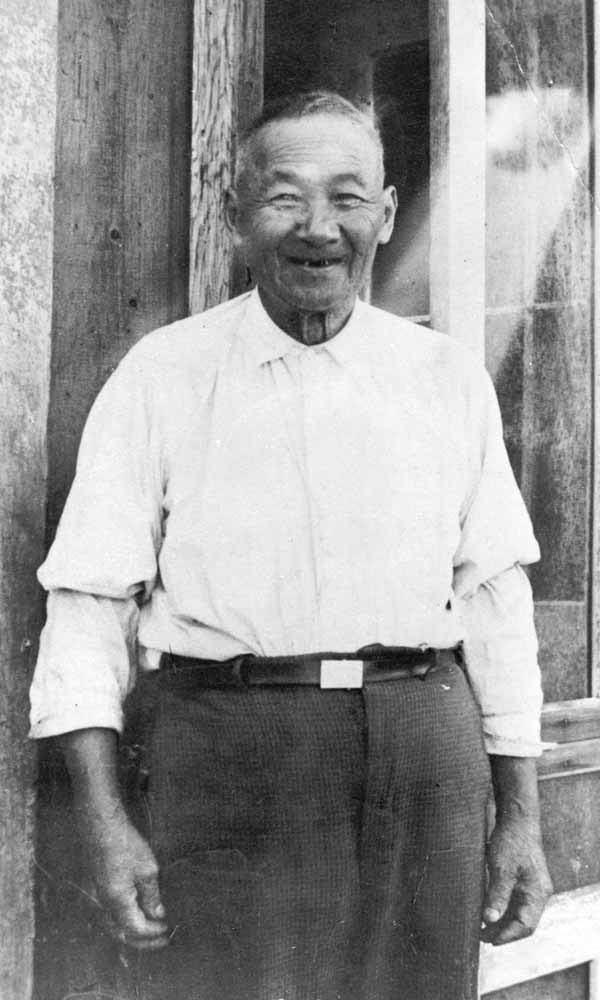
Quong Gee Kee
“Lum’s second wife was an American Chinese, born in Stockton. Yee Quong, also known as Quong Gee Kee, the only other Chinese remaining in Tombstone, knew Lum’s wife as a little girl in Stockton, where her father was a well-to-do merchant.”
Lum’s second wife was Mary Sing. Here, Quong Gee Kee, another of Tombstone’s famous residents, states that he knew her as a girl in Stockton, California. Was she the daughter of a well-to-do merchant born in Stockton? The mystery deepens and very little else was ever written contemporary to their lives … and deaths.
Quong was more than a cook and at times owner of the Can Can Restaurant; he was Mary’s friend. In 1935, a few years before his death in 1938, he visited Tom Sing in Tucson, whom he had known in Stockton years ago—perhaps reminiscing about better days, but lending credence to the statement above. Quong’s final wish, as told to A. H. Gardner, was to be buried next to his longtime friend, China Mary, in Boothill when he died in 1938. A friendship for all time.
Proven facts show that China Mary did exist; she did run a store for a few years, married twice, and had a child who died. She died on December 16, 1906, and was buried in Boothill Cemetery. Her name was Mary Sing.
So how did the “China Mary” legend grow with extensive feats of generosity and the title “Queen of Hop Town”? Let’s see what we can find.
Early novels and books about the Chinese in Tombstone were by Ned Buntline in 1885, Alfred Henry Lewis’ Wolfville Tales in 1897, and John A. Rockfellow’s The Log of an Arizona Trail Blazer in 1933. In his novel Tombstone Dick, the Train Pilot, Or, the Traitor’s Trail: A Story of the Arizona Wilds, Buntline only mentioned Chinese cooks and servants at the mines and one private servant for a female saloon owner. Lewis only mentioned a Chinese laundryman named Lung, and Rockfellow, a civil engineer and surveyor in Tombstone, only mentioned Chinamen as cooks and laborers. None of them ever mentioned a “China Mary, Queen of Hop Town.” Even Breakenridge’s Helldorado, published in 1928, made no mention of her.
The legend grew with C. L. Sonnichsen’s book Billy King’s Tombstone, published in 1942. Sonnichsen even wrote purported dialogue with China Mary, guaranteeing her employees wouldn’t steal and her generosity to Andy Darnell, paying for his recovery at Mary Tack’s boardinghouse. He wrote about her “rich silks and rare jewelry,” but made a huge mistake when he wrote that when her “hair was graying” she went back to China to perhaps marry. We already know she died and was buried in Boothill; her marker still stands there today.
Another author, Ben T. Traywick, even posted a supposed picture of China Mary who wore rich silks, which was later proven to be that of a woman in San Francisco, not Tombstone.
Grace McCool in 1954 furthered her legend when she wrote that “the town turned out en masse for her rites.” That was definitely not based on the funeral report in the Epitaph. And the Epitaph never called the Chinese section “Hop Town.” It was always referred to as Chinatown.
Odie Faulk’s article on China Mary in 1954 was very similar to Sonnichsen’s story. He added that she sold “opium to be used in Chinese opium dens and also by a few of the prostitutes who were hooked on it.” On May 25, 1885, an Epitaph reporter entered the opium den from an alleyway midway on the block of Allen Street between Second and Third streets. He witnessed Chinamen gambling as well as Chinamen and women smoking opium in nine bunks “built in tiers, like the berths of a ship.” Lastly, he witnessed the joss house where several women mourners were crying for a Chinese merchant who died in San Francisco. He did not mention a China Mary who sold opium.
This opium den was uncovered when a month after Mary’s death, on January 20, 1907, the Epitaph reported that Tombstone’s “Chinatown was gradually disappearing – the frame rookery on Allen street near the corner of Third occupied as a laundry, is being dismantled and the site cleared to make room for a cottage.” W. R. King now owned China Mary’s block 9, lot 10, and the lots across Allen Street where the tenements stood for 25 years. During excavation, underground passageways were found – and a box hidden in the floor with a flue providing fresh air to it. The box was for a Chinaman to use when hiding out from the deportation inspectors, like Jeff Milton.
To make the search for any Chinese woman—much less the infamous “China Mary”—difficult, many of the Chinese women in the United States were often referred to as China Mary. Why bother to learn their birth names when you can just generalize many of them with one name—China Mary? This makes it difficult and confusing to track the whereabouts of Chinese women and especially difficult in our situation to prove or disprove the existence of a Chinese woman running her district.
Chinese names were made of three parts: the clan name, the first name, and the family name. Quong Gu Kee is a good example of this. Quong would be his clan name, Gu his first name, and Kee his family name.
Chinese names were also difficult to write in English characters. Mostly, they were written the way they sounded, such as Maey/Mary or Choy/Joy/Toy. Many times, the term “Ah” was followed by the first name of the man. Census data shows many Chinese with the names Ah (Name).
To make matters worse when trying to search for information, on January 10, 1921, fire broke out at the Department of Commerce building in Washington, D.C., destroying the 1890 Arizona census papers that could have possibly helped locate more information about Mary Sing, such as confirming her age, occupation, residence, etc.—a missing link that can never be retrieved.
Is it possible that the stories attributed to a legendary character of Tombstone’s past are a compilation? The legend of China Mary includes items which may be attributed to others. The store’s contents and the employment agency match the ad of Charlie Lee Kong and Sue Wah in 1880. Her generosity matches that of known Tombstone women: Mary Tack and Nellie Cashman. On Mary Tack’s death, the newspaper wrote that she was “noted for her deeds of charity and her work in behalf of the poor and sick.”
We also were able to gather the progression of “China Mary’s” name. We know that she was first known as Mary Sing Choy. We don’t know much else about her marriage to Ah Gue, but we do know by way of the marriage certificate that when she married Ah Lum, her name on the form was listed as Mary Ah Gue and that she was a widow. Over the years, the newspapers reported her name as Maey Sing Choy, China Mary, Mrs. Ah Lum, or Mrs. Mary Sing, but no further mention of her position in Tombstone was ever made, even up to her death notice.
Can we associate Mary Sing with others named Sing? Several Chinamen were named Sing and could possibly be her relatives, but validating this is nearly impossible.
For instance, the Epitaph of June 17, 1880, reported that Sam Sing’s restaurant was on Fourth Street next door above Coffee’s meat market. He established his eating house in the fall of 1879, kept it in good order, and had a large number of paying boarders at $7.
Mary’s husband Ah Lum was a partner of Ah Sing in the Can Can Restaurant for a while. Ah Sing later became a vegetable gardener on the San Pedro.
Mary’s friend Quong Gu Kee visited his old friend Tom Sing in Tucson in 1935. He said that he knew Tom in Stockton years ago. So it’s possible these three men were relatives of China Mary’s.
Regarding Mary’s child who died young, perhaps this is her, but we cannot confirm these two Epitaph articles that referred to a child as being Mary Sing’s.
On August 23, 1890, a Chinese daughter was born to the wife of a merchant. And another article from December 1893 was republished in the Epitaph of December 17, 1953.
“The daughter of China Mary had a spasm this afternoon and the frightened mother rushed frantically through the streets for medical assistance. When she reached home again the infant was playing as unconcernedly as possible.”
Is this the same “China Mary” or simply another easy way to refer to a Chinese woman? We may never know. Was she a “wife of a merchant” and not a sole proprietor paying taxes on property and merchandise? Another leading question with no provable answer.
Also in reference to her status in Tombstone, around 1896 China Mary and Ah Lum were reported as each holding a twin of Quong Gu Kee’s. His wife and the twins were returning to China. This item was part of The Tale of Tombstone’s Chinese Dragon written by A. H. Gardner and published in the Epitaph on June 5, 1930. Note that he did not refer to her as “Queen of Hop Town.”
The truth may be difficult to prove about her role in ruling Chinatown, where she was born, who she was married to, birth records for a child born to her, and other parts of her life, but we were able to reveal some truths to her life and as the late Bud Collyer used to say on the TV show To Tell the Truth:
“Will the real China Mary please stand up.”
And she does!
~ China Mary did exist as a real person who lived in Tombstone from at least 1886 until her death in 1906.
~ She did run a store with merchandise from 1886 through 1890.
~ She watched as the Geary Act of 1892 required Certificates of Residence and those without were hunted by immigration inspectors.
~ She knew the sadness of losing a husband and a child.
~ Nine months before her death, she married Ah Lum, a man she had known all her life in Tombstone.
~ Her friend Quong Gu Kee, whom she knew even longer, was buried next to her in Boothill Cemetery in 1938.
When all is said and done, the legend of China Mary does outshine the proven facts of her life. But as was said in the 1962 movie The Man Who Shot Liberty Valance:
“This is the West, sir. When the legend becomes fact, print the legend.”
~~
While this article is jointly authored, special recognition is due to Kathy Franz for her depth of research and persistence in uncovering the historical records that made this work possible.
Great thanks is also due to Don Taylor, Tombstone Historian; Sandy Chen; Larry McFall; and Michaila Welch, State of Arizona Reference Archivist. Without their help, this article could not have been written.
